

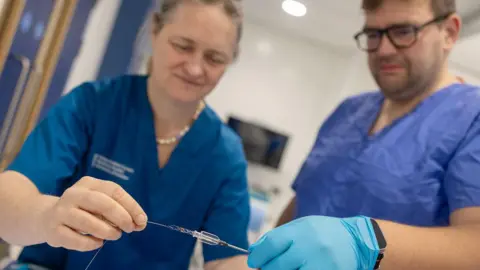
Medical professionals from Scotland and the United States have performed what is thought of as a historic brain operation using a robot.
The medical expert, from a medical institution, conducted the remote thrombectomy - the elimination of blood clots after a stroke - on a donated body that had been donated to medical science.
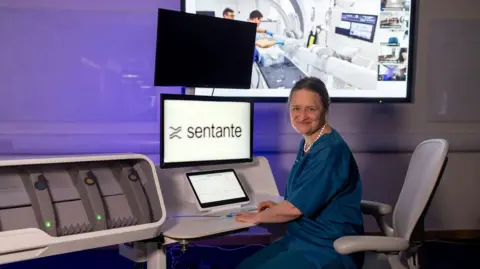
The surgeon was working from a treatment center in the location, while the body she was operating on while using the device was separately situated at the academic institution.
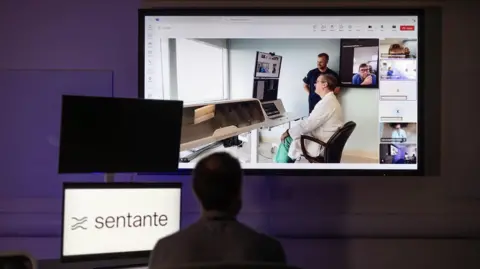
Hours later, a medical specialist from the American state employed the system to perform the pioneering long-distance operation from his American facility on a human body in Scotland over 4,000 miles away.
The team has described it as a potential "revolutionary development" if it gains clearance for use on patients.
The medics consider this technology could change stroke care, as a limited availability of professional intervention can have a major influence on the chances of recovery.
"It seemed like we were witnessing the initial vision of the coming era," said the medical expert.
"Whereas before this was thought to be theoretical concept, we demonstrated that all stages of the procedure can already be done."
The Scottish institution is the global training center of the global medical association, and is the only place in the Britain where doctors can treat medical specimens with biological fluid circulated in the arteries to simulate procedures on a actual patient.
"This was the first time that we could conduct the entire surgical process in a genuine medical subject to show that every phase of the procedure are possible," explained the primary researcher.
A healthcare leader, the head of a medical organization, labeled the intercontinental surgery as "a remarkable innovation".
"For too long, residents of isolated regions have been deprived of access to surgical intervention," she stated.
"This type of automation could correct the imbalance which persists in brain care across the UK."
How does the system function?
An blockage stroke occurs when an blood vessel is obstructed by a clot.
This interrupts blood and oxygen supply to the cerebral tissue, and neurons cease working and expire.
The superior intervention is a clot removal, where a expert uses catheters and wires to clear the obstruction.
But what happens when a patient can't get to a specialist who can do the procedure?
Prof Grunwald stated the study proved a robot could be attached to the same catheters and wires a doctor would conventionally utilize, and a medical staff who is with the patient could readily join the wires.
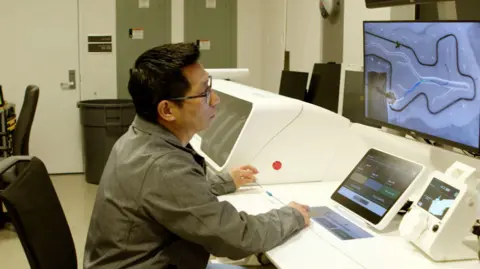
The specialist, in another location, could then manipulate and control their own wires, and the mechanical device then performs comparable motions in immediate sequence on the subject to carry out the clot removal.
The individual would be in a medical facility, while the doctor could perform the procedure using the automated equipment from any place - even their own home.
The lead researcher and the neurosurgeon could see real-time imaging of the body in the trials, and track developments in live conditions, with the Dundee expert saying it took only 20 minutes of preparation.
Tech giants prominent manufacturers were involved in the research to secure the network connection of the robot.
"To perform surgery from the America to the Scottish nation with a minimal delay - a blink of an eye - is genuinely extraordinary," stated the neurosurgeon.
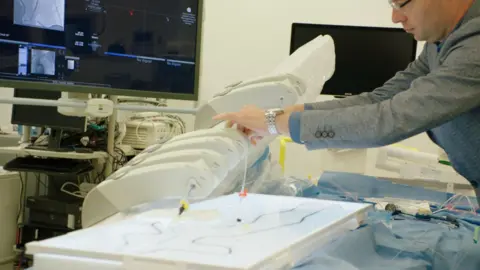
The future of stroke treatment
The lead researcher, who has been honored for her research and is also the vice president of the international medical organization, said there were two main problems with a conventional clot removal - a international lack of surgeons who can do it, and intervention relies upon your geographical position.
In the Scottish nation, there are just three locations people can obtain the treatment - Dundee, Glasgow and Edinburgh. If you don't live there, you must commute.
"The treatment is extremely time-critical," explained the lead researcher.
"Each six-minute postponement, you have a slightly decreased likelihood of having a good outcome.
"This technology would now offer a novel approach where you're independent of where you reside - conserving the precious time where your brain is otherwise dying."
Medical statistics revealed there were {9,625 ischaemic strokes|numerous cerebral events|


